
Understanding Dubai traffic rules is essential for anyone driving in the UAE to avoid heavy fines and ensure road safety. To comply with local laws, drivers must strictly follow marked speed limits (which include a 20 km/h speed buffer in Dubai), maintain a 0.00% Blood Alcohol Content (BAC), ensure all passengers wear seatbelts, and use hands-free devices for mobile phone calls. Tourists must hold a valid home country driver’s license alongside an International Driving Permit (IDP). All road traffic is continuously monitored by automated AI radar systems that issue instant fines for violations.
Driving on Dubai’s modern highways is an exceptional experience, but navigating the roads requires strict adherence to local regulations. Dubai’s Roads and Transport Authority (RTA) and Dubai Police enforce road safety using advanced AI radars and automated monitoring.
Whether you are a resident or renting a car as a tourist, mastering Dubai traffic rules ensures a safe, smooth, and stress-free journey in 2026.
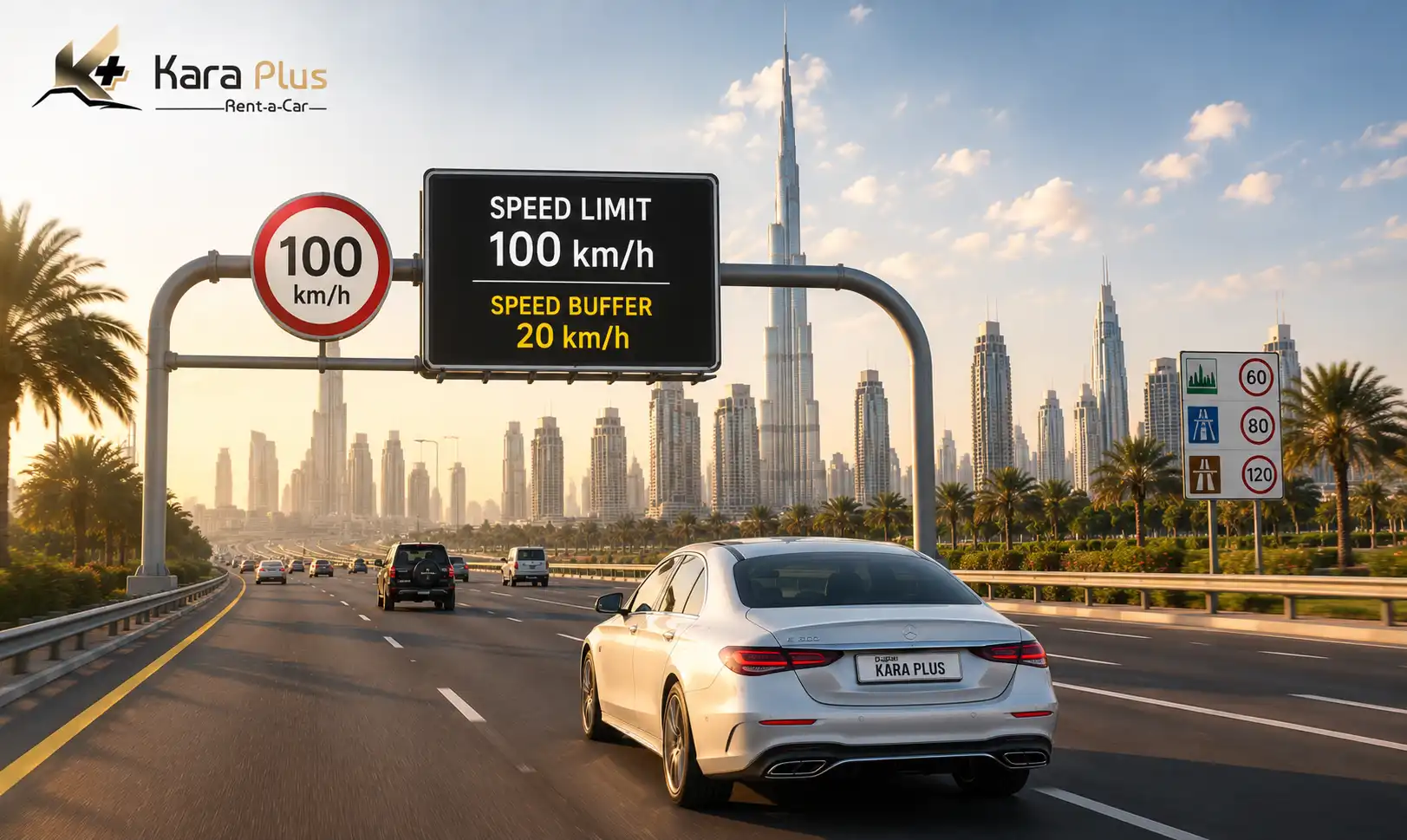
1. Speed Limits and the 20 km/h Speed Buffer
Speed limits in Dubai are clearly displayed on overhead boards and roadside signs.
-
Residential & Urban Areas: 40 km/h to 60 km/h
-
Main City Roads: 70 km/h to 80 km/h
-
Major Highways (e.g., Sheikh Zayed Road): 100 km/h to 120 km/h
Crucial Rule — The Speed Buffer (Grace Margin):
In Dubai and the Northern Emirates, an unwritten 20 km/h speed buffer applies above the posted speed limit. For example, if a sign indicates 100 km/h, radars will trigger only at 121 km/h.
Note: Abu Dhabi removed this buffer entirely. When driving from Dubai into Abu Dhabi, the posted speed limit is the absolute maximum allowed.
2. Salik Toll System Explained
Dubai operates an automated electronic toll system called Salik. There are no physical toll booths or cash stops.
-
How It Works: An electronic tag affixed to the windshield automatically charges AED 4 each time your vehicle passes under a Salik gate.
-
Rental Cars: All rental vehicles in Dubai come fitted with an active Salik tag. Toll charges are tracked electronically and billed at the end of your rental period (typically AED 4 to AED 5 per crossing, including agency processing fees).
3. Strict Safety Regulations: Seatbelts, Phones & Children
| Regulation | Legal Requirement | Fine & Penalty |
| Seatbelts | Mandatory for all occupants (front and rear) | AED 400 + 4 Black Points per violation |
| Child Safety Seats | Required for children under 4 years old | AED 400 |
| Front Seat Restrictions | Children under 10 years (or shorter than 145 cm) must sit in the rear | AED 400 |
| Mobile Phone Use | Handheld device usage is illegal; hands-free systems permitted | AED 800 + 4 Black Points |
4. Driving Under the Influence Laws
Under essential Dubai traffic rules, the UAE maintains a strict 0.00% Blood Alcohol Content (BAC) limit. Driving under the influence of alcohol or narcotics is a severe criminal offense.
-
Consequences:
-
Court-determined fines (up to AED 20,000 or more)
-
Immediate license suspension
-
Vehicle impoundment
-
Potential prison time followed by deportation for foreign nationals
-
5. Public Parking Rules and Zones
Public parking in Dubai is categorized into commercial, non-commercial, and special zones, monitored by RTA inspectors and digital scanning vehicles.
-
Paid Parking Hours: Generally operational Monday through Saturday from 8:00 AM to 10:00 PM (Sundays and public holidays are usually free, subject to local updates).
-
Payment Methods: Paid via the RTA Dubai app, SMS (to 7275), WhatsApp, or parking meters.
-
Key Restrictions:
-
People of Determination (Disabled) Spots: Unauthorized parking carries a severe AED 1,000 fine.
-
Double Parking & Blocking Traffic: Results in an AED 500 fine.
-
6. Dubai Traffic Fines and Black Point System
A core component of Dubai traffic rules is the Black Point System, designed to penalize repeat offenders. Accumulating 24 black points within 12 months leads to a driver’s license suspension or driving ban.
| Traffic Violation | Fine (AED) | Black Points | Impoundment / Action |
| Exceeding speed limit by < 20 km/h | AED 300 | None | None |
| Exceeding speed limit by 21–40 km/h | AED 500 | None | None |
| Exceeding speed limit by 41–60 km/h | AED 700 | 6 Points | None |
| Exceeding speed limit by > 60 km/h | AED 1,000 | 12 Points | 30 Days Impoundment |
| Exceeding speed limit by > 80 km/h | AED 3,000 | 23 Points | 60 Days Impoundment |
| Running a Red Light | AED 1,000 | 12 Points | 30 Days Impoundment + AED 50k Release Fee |
| Reckless Driving / Sudden Swerving | AED 1,000 | 6 Points | None |
| Driving Without Insurance or Registration | AED 500 | 4 Points | 7 Days Impoundment |
7. Tourist Driving Requirements and Rental Car Insurance
Tourists planning to rent a car and follow Dubai traffic rules must meet specific age, documentation, and insurance requirements.
Minimum Driving Age
-
Legal Driving Age: 18 years old.
-
Minimum Rental Age: 21 years old for standard vehicles; 25 years old for luxury or high-performance supercars.
Required Documents for International Visitors
-
Valid Original Driving License (from home country)
-
International Driving Permit (IDP) (GCC, US, UK, EU, and select country license holders may drive using their home country license directly)
-
Passport with valid UAE Entry Visa / Stamp
Vehicle Coverage Types
-
Basic Collision Damage Waiver (CDW): Covers basic damages. If you are at fault, you must pay the insurance excess fee plus vehicle downtime costs.
-
Full Coverage (LDW): Waives major damage costs if an official police report is provided, limiting liability to standard excess fees.
-
Super Collision Damage Waiver (SCDW): Maximum protection. Covers zero deductible, minor scratches, windshields, tires, and eliminates vehicle downtime charges.
Frequently Asked Questions
What happens if I receive a traffic fine in a rental car?
Traffic fines are automatically logged against the vehicle plate number. The car rental company pays the fine to RTA/Dubai Police and bills the amount to your credit card or rental invoice with an official receipt.
Is an International Driving Permit (IDP) required for all tourists?
No. Citizens of GCC countries, European Union nations, the USA, Canada, UK, Australia, and select other recognized countries can drive using their national license. Visitors from other nations must present a valid IDP alongside their original license.
What should I do if involved in a car accident in Dubai?
Do not leave the scene. Move the vehicle out of active traffic if safe to do so, call Police (999), and request an official accident report. Insurance companies will not process claims without an official police green or red slip.
Can I turn right on a red light in Dubai?
No. Turning right on red is strictly prohibited unless there is a dedicated slip lane separated by a physical island with a yield or clear signal.
How do I pay or check traffic fines in Dubai?
You can check or pay active traffic fines online through the Dubai Police official website, the RTA smart app, or at RTA customer service centers.